Overview
Fluor wanted employees to find company knowledge simply by asking a question.
Fluor is one of the world’s largest engineering, procurement and construction companies, and decades of complex projects have left it with an enormous body of technical and corporate knowledge. That knowledge is only valuable if people can reach it. Too often, finding the right document meant knowing where it lived and guessing the exact words it used.
Fluor partnered with Chiron IT to explore a different approach: an AI agent that employees could talk to in plain language, one that would search Fluor’s own knowledge sources and answer from them. From the outset, the goal was more than a chatbot demo. Fluor needed a foundation it could build on, secure for enterprise use and flexible enough to support new AI use cases as the technology evolves.
Project at a glance
An AI agent foundation built on Microsoft Azure.
Industry: Engineering, procurement and construction (EPC)
Solution: Conversational AI agent that answers questions from company knowledge
Core technologies: Azure AI Foundry, Azure OpenAI, Azure AI Search, ASP.NET Core and Semantic Kernel
Data and storage: Azure Cosmos DB and Azure Blob Storage
Integration: Microsoft Teams integration path and Microsoft Entra ID
Stage: Proof of concept and technical validation, followed by an enterprise readiness roadmap
Problems and challenges
Company knowledge was hard to reach, and a basic chatbot would not have been enough.
The first challenge was the knowledge itself. Fluor’s documents are dense and technical, and the same idea can be described in many different ways. A traditional keyword search, or even a single AI-generated search, often missed the passage that actually answered the question.
The second challenge was conversation. Real questions rarely come one at a time; people ask a follow-up, narrow it down, then compare. A system that forgot everything between messages would force users to repeat themselves and quickly lose their trust.
Finally, everything had to meet enterprise standards. Several Azure AI services needed to work together without tying the solution to a single AI model, and any path to wider use depended on Fluor’s own requirements for identity, security and access control.
Solution
An AI agent that understands the question, searches smarter and remembers the conversation.
The most important design decision was to stop treating search as a single attempt. When an employee asks a question, a GPT-5 agent first works out what they actually mean, then rewrites the question into three to five different search variations. Each variation approaches the topic from a slightly different angle, so the system is far more likely to find the right material, even when the user’s wording doesn’t match the document’s.
Azure AI Search then retrieves the most relevant content from Fluor’s knowledge sources, and an AI model writes an answer grounded in that content rather than in general internet knowledge. Behind the scenes, the platform keeps each user’s conversation, so a follow-up like “and what about the second phase?” makes sense without the user repeating anything.
Choosing the right model was treated as an evidence question, not a guess. Chiron IT ran GPT-4o and GPT-4.1 side by side on the same knowledge content, and GPT-4.1 followed instructions and used context more reliably, so it became the preferred choice.
Conversational AI backend
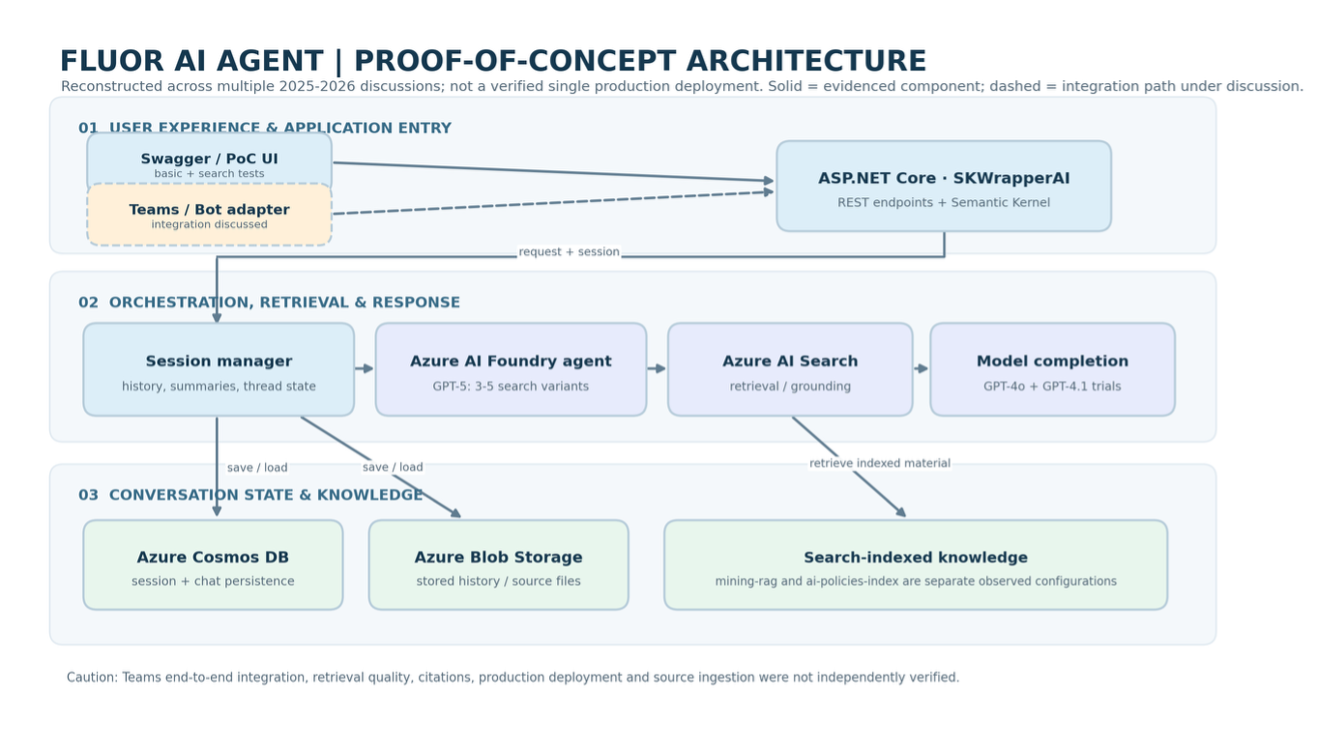
The core application layer was a C#/.NET service (SKWrapperAI / SKWrapperAPI in historical discussions). It exposed API operations through Swagger and used Semantic Kernel to communicate with AI models and search capabilities. The initial demonstration supported both basic chat and a source-search path.
Persistent identity, sessions and memory
Session management preserved prior turns using stable user/session keys. Implementation discussions identified ChatHistoryAgentThread, BlobChatSessionService and CosmosChatSessionService. Later descriptions reported conversation summaries and Cosmos persistence in the existing wrapper. The precise storage authority and retention implementation changed between iterations and require verification before claiming one canonical design.
AI knowledge retrieval and grounding
Azure AI Search was integrated into the knowledge-enabled path. The mining-rag knowledge source was used in Foundry trials, including a Freeport earnings-related query; a separate ai-policies-index configuration handled page-level policy documents. The work also examined document link recovery when metadata_storage_path was missing. Search mode, relevance thresholds and citation fidelity were subjects of evaluation rather than established production KPIs.
Reasoning-assisted search refinement
The prototype was described as using a GPT-5 Foundry agent to reason about the user question and generate approximately three to five semantically distinct query variations. This separates query understanding from retrieval and final response synthesis; it also creates a natural place for guardrails, relevance evaluation and model-specific tuning.
Model comparison and agent experimentation
In October 2025, two RAG test agents using GPT-4o and GPT-4.1 were run against the mining knowledge base. GPT-4.1 was preferred at that point based on observed instruction following and query-context sensitivity. Other proposed specialists (summarization, classification, extraction, planning, reflection and a multi-agent orchestrator) remain design explorations unless independently verified.
Channel and identity integration
Azure Bot Service and a TeamsAgent-based gateway were discussed as a channel-neutral adapter. The proposed contract forwarded tenant/user identity and the message to SKWrapperAI; On-Behalf-Of (OBO) token exchange and Microsoft Graph-dependent tools were explicitly deferred. A complete customer-ready Teams rollout was not proven by the retrieved discussions.
Architecture
A modular design where every part can be improved on its own.
Rather than building one tightly connected application, Chiron IT separated the platform into independent layers: the channel people use to ask questions, the AI orchestration that interprets them, the search that finds content, and the storage that remembers conversations. A request passes through each in turn, from the employee’s question to a saved, grounded answer.
This separation is what makes the platform future-proof. A newer AI model can replace an older one without touching search. A new knowledge source can be added without changing the conversation logic. And the same backend can serve a web app today and Microsoft Teams tomorrow, with only a thin adapter in between.
Development process
From a first working demo to an enterprise roadmap in nine months.
The project began in August 2025 with a deliberately simple goal: prove that the core idea worked. Within weeks, a working prototype could answer general questions and search company sources. The team then added the piece that turns a demo into a usable tool: conversation memory.
In October, the AI agents were connected to real knowledge content, and the model comparison guided the choice of GPT-4.1. The winter months brought more practical work: improving how source documents are linked so answers can point back to their origin, and fine-tuning access permissions between services.
By February 2026, the GPT-5 search refinement was in place, and a security review mapped exactly what a production deployment would require. That review led, in May, to a target architecture for a secure, company-owned Azure environment, turning a successful experiment into a clear plan.
Project team
A small, cross-functional team working closely with Fluor.
Chiron IT brought together AI and .NET engineers, who built the core service and its conversation memory; AI solution architects, who designed the agents, ran the model comparisons and shaped the search strategy; and Azure platform engineers, who handled hosting, identity and integration. Fluor’s stakeholders and security reviewers were involved throughout, setting requirements and ensuring every design decision fit the company’s enterprise standards.
Security and privacy
Enterprise security was part of the plan from the start.
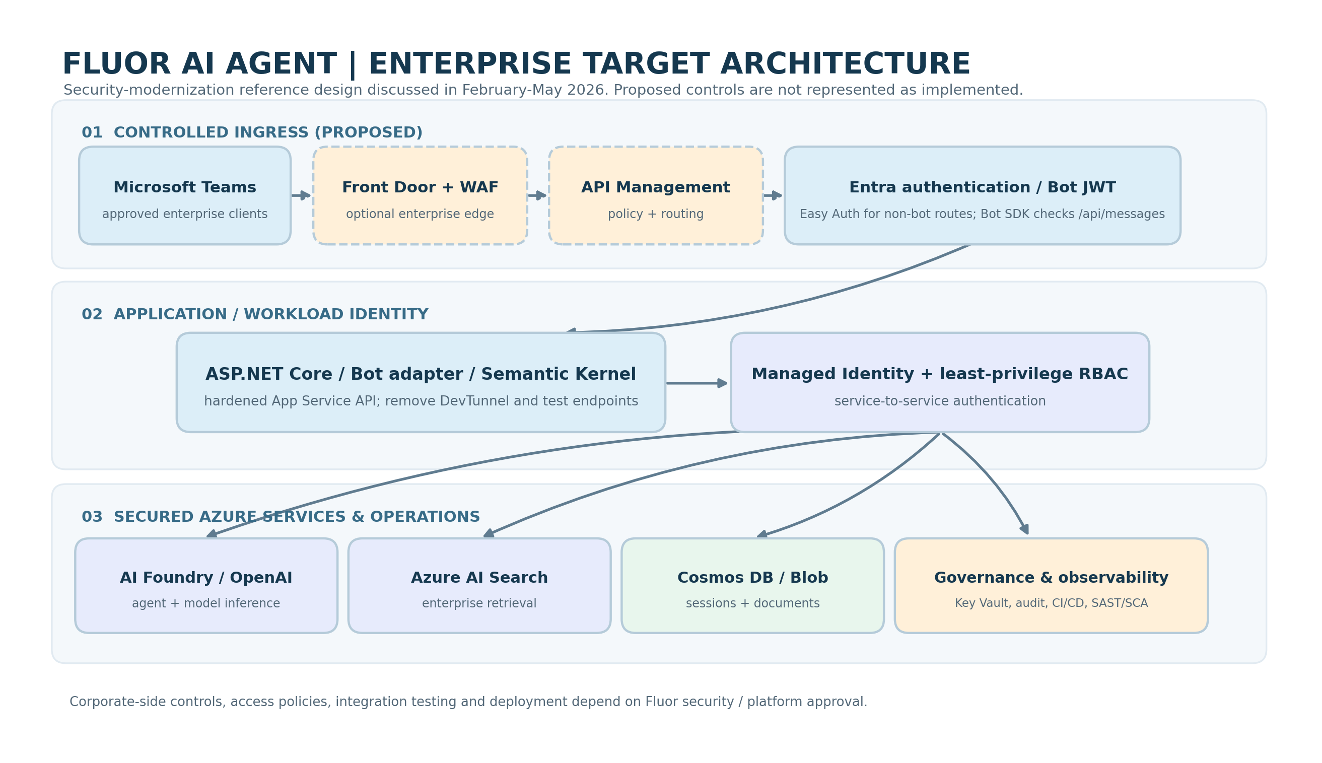
Proofs of concept are built for speed, and enterprise systems are built for trust. Chiron IT was clear about the difference and defined a deliberate path from one to the other rather than assuming a working prototype was production-ready.
The resulting roadmap has every user and service sign in through Microsoft Entra ID, with each component allowed to reach only the resources it needs. Managed identities replace stored passwords and keys, entry points are protected and network access is controlled. Deployment runs through secure pipelines with monitoring and auditing. Just as importantly, the plan sets clear rules for data: which content can be searched, how source permissions are respected and how long conversations are kept.
Benefits
A faster, more natural way to reach company knowledge.
For Fluor’s teams, the value is a change in how they reach information. Instead of hunting through repositories, an employee can ask a question the way they would ask a colleague and get an answer drawn from the company’s own content. Because each question is searched several ways, the answer is more likely to be the right one, and because the agent remembers the conversation, digging deeper feels natural.
For Fluor as an organization, the larger benefit is the foundation itself. The platform isn’t locked into one AI model or one interface, so future AI use cases can be built on what already exists rather than starting each time again.
Results
A validated AI foundation and a clear path to production.
The project gave Fluor a working AI agent that answers questions from company knowledge, remembers conversations and uses GPT-5 to search more intelligently. The model choice was backed by side-by-side testing, and the modular architecture lets models, search and channels evolve independently.
Equally valuable is what comes next. Fluor now has a security and architecture roadmap that defines exactly what a production rollout requires, so the step from experiment to enterprise tool is planned rather than improvised.
Lessons learned
What this project taught us about enterprise AI.
The clearest lesson is that an AI demo that answers questions is only the beginning. In an enterprise, identity, permissions and reliable sources matter as much as the AI model itself, and planning for them early saves significant rework later.
We also saw the value of keeping each layer independent. Separating search, AI models and storage made it possible to test and improve each one without disrupting the others. And because users need to trust what the agent tells them, accurate source information proved essential: an answer is only as good as the documents behind it.
The natural next steps are to measure answer quality against a structured set of test questions, complete the security roadmap and bring the agent to a pilot group of users, including through Microsoft Teams.